The Marsh Pride’s Family Vacation

Sunday, May 9, 2010

Posted by Sara Blackburn at 4:50 PM

This morning I drove out of camp to be met by a gang of thirteen very special lions. Within the bunch was a number of youngsters, along with some familiar faces.
Just outside of Serian, Chemi-Chemi (the spring) is in the northern reaches of the Mara North Conservancy on the Mara River. It’s certainly some distance from the Musiara Marsh, which is why I was surprised to identify the lions as none other than the infamous Marsh Pride.
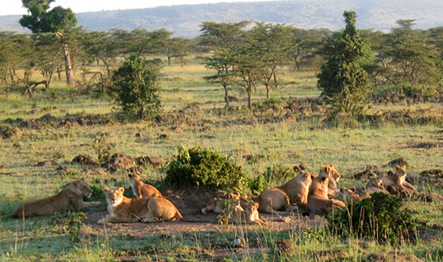
marshpride
How many lions?!

Four adults – Siena and Joy, Bibi and White Eye were lazing in the sun with Romeo and a whole assortment of cubs. Joy's two male cubs, now around 15 months old, and six cubs around 5 months old – four belonging to White Eye and two to Siena – were all happily playing in the long grass and exploring their new environment.

climb The cubs practiced their tree climbing skills amongst the Acacia

The pride have been slowly working their way into the conservancy, and have been spotted on a number of occasions. Although they are far from their home, the territory is open, as many of the River Pride lions are residing on the escarpment. Romeo too has visited the area often to mate with new females.
A lion’s pride territory is not as fixed as you’d think. Although lions spend a lot of time in a core area, prides rangers are large and overlapping. However, two prides will not occupy the same shared territory at the same time, and will advertise their presence to neighbouring prides by roaring.

White Eye the one-eyed lioness. A caring mother but also a fierce hunter

The Marsh Pride is also in a state of flux – with Clawed (Mpengo) seemingly absent, Red no longer with us and the five sub-adults from the females’ last litters, the large family has split into a number of sub-groups. It seems that White Eye and Bibi are forming an alliance with the Three Graces – including Siena and Joy – whilst Lispy remains with the daughters of the pride. Lispy has also been seen flirting with two handsome chaps from the border of the Marsh. Perhaps Romeo and Clawed’s reign is facing an uncertain future?
However the pride forms, here’s hoping that the Marsh females will be as successful at raising this family as they were with the last. They’ve got a lot of experience on their paws!
Sara

A Dangerous Duo

Tuesday, April 13, 2010

Posted by Sara Blackburn at 7:08 PM

Big males are pouring into the Mara North Conservancy left right and centre. Not only have three young males joined the three Cheli and Peacock lionesses, but there are now two impressive boys on the scene. Seen down Ereyet Angopito – where Kioni is usually found– this pair are on the hunt for their own pride.

male2
One of the males with an impressive dark mane

I’m not sure where these boys have come from, or how long they will spend in the area. They could simply be travelling through, and I’ll have to keep a lookout for them before I know more. Nura, Lilly and Siti are in season and mating with the three younger males – perhaps this pair have come to challenge them? Caesar still hasn’t been seen, and he’d better be careful – one of these males he may be able to handle, but together, these boys pose a real threat to Caesar.

newmalw3
‘Aswad’ means ‘black one’ – his mane is a lot darker than his companion’s.

new male 2Sango’ is Aswad’s companion.

These two have earned the names ‘Aswad'’ – meaning the black one – and ‘Sango’, which means ‘braided hair’ – his mane is slightly matted in places. Sango is probably slightly younger than Aswad, as his nose is still pink and his mane is not as well developed. He’s probably around 5-6 years old. Both of these males have a distinctive left ear, in particular Sango, pictured above.
I’ll let you know if these boys are here to stay. With five new males in the area, who knows what will happen through the rest of the rainy season?
Sara

A Turnover?

Wednesday, April 7, 2010

Posted by Sara Blackburn at 4:48 PM

For the past few months, Caesar has been top dog in the Cheli and Peacock pride. After Siti and Lilly lost their cubs, Caesar mated with them. Together with Silver’s little of four, fathered by Caesar, the pride was set to build rapidly in numbers.
However, upon my return, Caesar is nowhere to be seen. There are thoughts that he may be with Lilly, who is rumoured to have a new litter, but as of yet, we’re in the dark. It’s been over 2 months since the big boy was seen.

lady looksSiti looks out: where’s Lilly and Caesar?

In his place with the Cheli and Peacock pride are three strapping young lads. Around 4 years old, this trio are strong enough to compete with a lone male like Caesar, and they certainly show it. Buffalo and elephant are a firm favourite with these boys – they’re not messing around! It’s typical for young adult males to form coalitions when they’re forced to leave their natal pride – it allows them to co-operate in hunting, steal kills from hyena and other predators, and gives them a major advantage for acquiring their own pride. Whatever the deal is with lions, there’s always strength in numbers. This is what makes lions so successful as the only social cat.

threemales2 threemales1
Two of the three boys: they’re about 4 years old

Unfortunately, Silver’s four tots are nowhere to be seen. Both her and Siti have been with the three males for some time now, and it’s unlikely that they would tolerate young cubs belonging to Caesar. It’s a real shame – all three lionesses have now lost at least one litter each, and with rogue males prowling the conservancy, who knows if their next litters will be safe?
It’s certainly a trying time for these four girls. I hope that whichever males join them stay for long enough for them to successfully raise their cubs to adulthood.
Sara

Changing Scenes

Wednesday, March 24, 2010

Posted by Sara Blackburn at 5:17 PM

So I’m finally back in the Mara North Conservancy after spending some time in the UK developing a new lion database. Hopefully everyone will find it easy to use, and enjoy it, too. I’ll let you know when it goes live.
Things have changed in the MNC – the rains are here, and everywhere the grass is green and lush, and rather long. It’s a bit of a challenge getting around. There’s a distinct lack of grazers both here and in the reserve, but leopard and hyena numbers are at an all time high. As for the lions, there’s some familiar faces around, most prominently the Cheli sub-adults, who are up to no good as usual…

punch Maskio (meaning ‘ears’) and Amber play rough

fall
No way I’m going to lie on the muddy floor and mess up my fur!

The lion scene is changing, too. Marley’s group has split, interestingly, and the younger cub Mtoro and his pride-mate Maji have joined up with Cheli cubs. Kioni, Marley and the other youngsters haven’t been seen for a while, and there is no clue as to why Mtoro and Maji are now on their own.
It’s highly unusual for unrelated lions to join another group, and I’m still not sure what the true outcome of this pairing will be. Yesterday morning, Mtoro was on the receiving end of a little bullying, but in the afternoon, everyone was snoozing together quite happily. Sebastian and Rescue are already looking impressive, and good on these young lions for doing so well without mum.

william&cheli
Mtoro (right) with Rescue and Sebastian (standing).

In other news, an elephant carcass brought in predators and scavengers far and wide. Together with the drizzle it made for an interesting – if somewhat grisly – photography opportunity. I’m now armed with a video camera, so hopefully there will be some videos coming this way before too long.

willima Poor Mtoro's a little lost. He’s been through two mums already.

Three new males turned up at the scene of the crime, none of whom I recognized. Males of around 4 are usually on their own or in a coalition of other males before they manage to win over their own pride. In a couple of years they should be in their prime. I’ll try and get some photographs of these boys soon.
More soon. It’s good to be back!
Sara

Learning About Lions

Sunday, January 24, 2010

Posted by Sara Blackburn at 11:01 PM

I’ve been a bit quiet of late as I’m currently in the UK, working to develop the various media elements of the Mara Predator Project. Whilst this means no fieldwork for a few weeks, hopefully there’ll be a swanky new website packed full of information and cool features. It’ll be a more interactive version of the database at www.livingwithlions.org/mara.

It’s a good chance to tell you all about some of the community work we’ve been doing along with Serian Camp. Education is a integral factor in promoting mutual coexistence between people and predators, and a key goal of ours is to help people understand the importance of lions to their community.

There’s nothing kids like doing more than getting messy, so we went to a local school to do some art activities on the subject of lions. After talking to the children about the local lions, they each drew their favourite. I have to say I was very impressed with their pictures – many of the children haven’t done art before as it’s not part of their syllabus at school. Together we made a great display for each class.

school1 The children each drew their favourite lions. They all really enjoyed looking
through the photographs and books – most of them have never seen a lion.

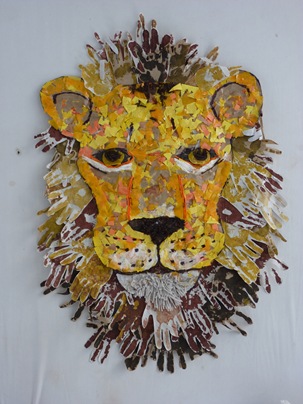
All of the children helped to make a giant collaged lions head with bits of yellow card and plastic. They all really enjoyed getting messy making handprints for the mane, and soon we had a great display for the school. The lion puppets went down a treat, too!

school (102) Getting messy!

As well as being great fun, there’s a serious side to the workshops. Hopefully we can encourage the local younger generation to have a positive view of lions, and demonstrate their respect for lions through tolerance and conservation. Essentially, jobs in tourism such as guiding are highly valued, which promotes an understanding and passion for wildlife. Working with these children, as well as lodge guides, will help build positive attitudes towards lions and other predators.
 lion

Above is the finished result. Pretty good, eh??

Sara

A Good Mum

Thursday, December 31, 2009

Posted by Sara Blackburn at 1:54 AM

It’s been a few weeks now since Lilly introduced her cubs to the pride. Lilly never seemed comfortable, and unfortunately her two cubs didn’t survive. When I left her, Silver still had her four babies tucked away in a lugga, but they have since been introduced to her pride mates and a bigger world!

fourCome on mum!

As you can see, these four fluffy bundles are in great health. The next few months will be a testing time for both mum and cubs, but with good rain and plenty of food, they have a good chance of making it to adulthood. These three lionesses are great hunters, and successfully raised seven cubs through this year.
Following the loss of her cubs, Lilly has been mating with Caesar. If they mate successfully, Caesar will have sired three litters. Lionesses often mate with several males when they are in heat, but as the only resident pride male (and a magnificent one at that!) with no real challengers, Caesar’s building an impressive dynasty!

caesar & lilly Caesar and Lilly. She can be easily recognized by the area of patchy fur by
her left eye. She’s also rather fluffy.

Silver’s cubs are growing fast. They still have woolly fur, camouflaging spots and short tails. They will have to wait until they are five months of age before they grow a sleek coat and develop a tail tuft.

cubThe cubs are growing fast!

The cubs will be heavily dependant on their mother for a long time, and will suckle until they are around 6 months old. By the time they reach 3 months though they will develop a taste for meat, and will soon be fighting dad over first dibs on dinner!

suckling Mum has her paws full with four hungry cubs to feed

Hopefully we can begin the countdown to the arrival of Lilly’s cubs now. Fingers crossed that she will have more luck this time.
Happy Christmas and New Year from the Mara lions!
Sara

Facts of Life

Saturday, December 12, 2009

Posted by Sara Blackburn at 9:27 PM

The first few weeks of life is tough for little lions. They face many dangers, from heavy rains and floods to angry buffalo and sneaky hyena.


Last week, Lilly carried her two babies to Caesar and Siti. Both cubs and mum seemed comfortable and relaxed and I felt no need to worry.


littleones Lilly’s two cubs snuggle close


Sadly, Lilly became increasingly detached from her babies. After introducing them to the pride a little early, one small cub was seen lying some way from the group, and sadly was not seen again. When she took the remaining cub to a kill, she devoted most of her attention to her meal, leaving the little one alone amongst hyenas. Since then, there has been no sign of the cub.


lilly Lilly became uninterested in her babies…


Abandonment does occur with lion cubs, but this usually occurs with single cubs or those which are weak or injured. Lionesses also abandon cubs if there is a shortage of food, although I doubt that this is the case with these powerful, healthy girls. Perhaps Lilly sensed that her cubs were not well, or felt uneasy in the presence of the other lions? She did move the cubs regularly, which may have indicated that she was not settled.


This is a real shame, but the good news is that Silver’s cubs are still doing very well. My fingers are crossed for these ones, but I think they will do just fine. Lions are capable of reproducing quickly in the right conditions, and with Caesar resident in the group, she’ll soon be mating.


I’ll be keeping a close eye on the remaining four little ones. This group has certainly been through rough patches with their cubs... let's hope this trend doesn't continue.


Sara

First Glimpses

Sunday, December 6, 2009

Posted by Sara Blackburn at 7:30 PM

Over the past few days we’ve been lucky enough to have some snippet views of the new cubs. They’re tiny! When they’re born, lion cubs weigh less than 1% of their mother’s body weight.


hidden

These cubs are really well hidden – well done mum!


tiny cub

What a cutie!


Silver has hidden her babies deep inside a lugga, away from the pride. Lilly has also been hiding her cubs, but has been seen moving them to new locations. Both the elements and animals such as buffalo and hyena pose a threat to new cubs - moving them regularly prevents them from being detected.


lilly's cubs Lilly’s two babies stay close to mum


cub2

These little ones already have a sense of adventure


Yesterday was a special day for the cubs as they were introduced to the pride and to each other. This time, Caesar looked relaxed whilst Lilly brought her two little ones over to meet her pride mates. Later in the day, five cubs were seen together. They’re about two and a half weeks old and still a bit wobbly, and so are still carried by their mums.


emcarry Cubs are carried for a few weeks until they can keep up with mum


We’ll have to keep a close eye on the cubs over the next few weeks. Lion cubs are most at risk during this fragile time – fewer than 20% of cubs make it to adulthood. These lionesses have just successfully raised 7 cubs to bouncy 2 year olds though, so six shouldn’t be a problem!

Sara

More New Arrivals!

Saturday, November 28, 2009

Posted by Sara Blackburn at 10:07 PM

I’ve been twittering on about the expectation of new cubs from both Lilly and Silver, and it brings me great pleasure to announce the arrival of six new little ones!

Silver has had four cubs, whilst Lilly has had two. At this early age, both of the mothers have moved away from their sister and Caesar, and are nursing their babies in thick woodland. At this age, lion cubs are at risk from buffalo, leopard, hyena and even baboons, and mum must have a careful eye. She will leave them in a safe place such as a hidden lugga whilst she hunts.


lady cub Mothers hide their cubs away from the pride and out of harms way


When the cubs reach around three weeks of age, they will be introduced to the pride, and after a couple of months will follow their mothers around. New cubs are a joy to watch, and I hope that these new arrivals will be lucky in life.

Away from the mothers, Caesar and Siti have also been mating for the past few days. This means that their previous paring was not successful. In fact, lions may have to mate up to 1,500 times for a pregnancy to occur!

Both Lilly and Silver are keeping their cubs well under wraps, but I’ll post some photos as soon as I get a sneak peak!

Sara

Collaring Laikipia’s Lions

Friday, November 20, 2009

Posted by Sara Blackburn at 1:05 PM

For the past two weeks I’ve been in Laikpia with Living With Lions’ Laikipia Predator Project. I’ve been showing local lodges how to help by identifying lions and recording sightings in a similar way to our Mara project. Since 1997, the Laikipia Predator Project has helped conserve large carnivores by improving livestock practices, studying the behaviour and ecology of predators that live alongside humans, and monitoring their response to conservation action.
Alayne Cotterill and Steven Ekwanga use some funky equipment to study lions in a challenging landscape. Laikipia lions are shy and elusive, and so radio collars are used to follow their movements. Whilst VHF collars allow one to physically track a lion by following a signal, GPS collars are all the rage, allowing for a lion’s movements to be continuously recorded. You can read more about collars here, and follow some of our GPS collared lions in the Chyulu Hills here.
nemesi This lion is wearing a VHF collar, which allows her to be tracked using telemetry
radio tracking Hmm… where are those lions?

Alayne has a collared lion in every group, which allows her to track most of the lions in the vast area of Laikipia. We wanted to change one lion’s collar from a VHF to a GPS collar, a process that involved bating and darting the lion.
Contrary to popular belief, collaring is neither a risk to the lion’s health or a bother to its everyday life. Lethal overdoses are impossible with the specific drugs used, and the lions show no reaction to the collar upon waking. Collars have been widely studied for their influence on animals, and all evidence shows that hunting, socialising and all other behaviours are not affected in any way. In fact, collared lions are less likely to be killed.
alayne collaring Alayne collaring a lion and taking samples for DNA analysis
We found our lion, LF167, with her pride-mate and several sub-adults by using the VHF tracker. In order to change the collar, we needed to dart the lion to put it to sleep. With a cow carcass in tow and a recording of a baby buffalo in distress, we tried to call the lions out into a safe area for darting. It is important that the lion does not go down in thick bush to avoid distress, and unfortunately the lions we playing hard to get! We left the lions at dusk, and by the time we returned the next day, they were long gone.
The information that Alayne gets from her collared lions is vital in studying their movements. Her data is showing that lions avoid communal areas with lots of people, and prefer wild game over livestock.
I’m back in the Mara now and looking forward to catching up with the locals. Silver and Lilly may have had their cubs by now, and so it’s time for a scout!
Sara

An Old Face

Saturday, November 7, 2009

Posted by Sara Blackburn at 11:40 PM

Last year, the River Pride contained three core females on the Serian side of the Mara River. Asali, Mandisa and Tailend were three sisters that we saw often, with all three females having litters close to camp. However, since March, no-one has seen these lionesses again. Last seen by Musiara and the Masai Mara Reserve, we lost track of our favourite trio and they fell off the map. Their favourite haunts around Maternity and Serian are now occupied by Sophie and Marley and the boisterous teenagers. Even though Tailend and Mandisa's cubs didn’t survive, Asali still had two healthy cubs.
After seven months of absence, I was beginning to worry about these girls. A few days ago I set out early one morning after getting a call from Dixon and Jonathan, two of our guides, that there were lions on Serian Hill.
Driving out of camp I found some familiar faces close to camp on Mulima Maui (Rocky Hill in Swahili) after tracing up from some spooked animals. Kahawa and one of Kioni's daughters were chilling out in the bushes. Happy with my I.D., I was about to head off when Dixon radioed through that there was a mother and two cubs close by.

tailend&cub Mother and cub in stride

Over the hill, and meters away from the lazy youngsters was Tailend, with two little cubs in tow. I was so glad to see her, and chuffed to see that she had new cubs of about She was munching on a baby Tommy, but looked like she was in a hurry, and after following her at a distance across two luggas and several kilometres, we lost sight of her. She looked very fit and healthy, and my thoughts are that she has been living across the river.

tailendeat Tailend and her two cubs, tucking in!

Mothers usually leave the pride for a number of weeks when they have new cubs, and so Tailend may be alone. However, I am optimistic that she will join up with her sisters soon, and hopefully on this side of the river. I’ve still got to find those girls!

tailendcubThis little one’s about 4-5 months old

I’m off to Laikipia now, but will keep you updated on our Mara lions when I return.
Sara

Lonesome Traveller

Monday, October 19, 2009

Posted by Sara Blackburn at 1:57 PM

Yesterday, a report came through of an unknown male lion, resting close to camp in the bush we call Military. Naturally I wanted to check this guy out, so I jumped in Suzie (my notoriously bouncy 4x4) to see if I could find him.
The lion hadn’t moved, and wasn’t in the best of condition. Lying down, his ribs were rather prominent, and when he got up to shift position the limp on his leg was somewhat obvious. I’m not really concerned though – a few good meals, and this old chap should be good as new. Clawed was in a similar state a few months ago after an injury to his jaw, but now is on top form.

frank Who’s this old boy?

At first I though that our visitor was a new lion, but on closer inspection, identified him as Badawi. He’s certainly come a long way from home, as I first found him past Mara Offbeat on the other side of the Olare Orok river. Badawi is roughly 8-9 years of age, and you can see his profile by going to www.livingwithlions.org/mara and clicking through to the green ‘ACACIA PRIDE’ area.
This morning Badawi was nowhere to be seen, and was obviously just travelling through. With Caesar on top form, and Marley holding his little pride of six, there’s no room here for an old man like Badawi. I’m not sure why he’s come all the way up here – perhaps he has been ousted from his pride by new males. There seems to be a lot of fluctuation in the Acacia Pride groups, as Offbeat have also reported that some of their cubs were killed after a takeover by two new males.

caesarsunset Caesar looks out across his territory

We’re still waiting for Silver to have her babies, too – yesterday she was looking rather round after having the spoils of both an impala and a topi kill. She was relaxing with Lilly, whilst Siti and Caesar strode out onto the plains. It looks like they’ve made up, and are quite the couple!

silverclose Silver will have her little ones soon

We’ve been out filming again too, and have found Marley’s pride on a couple of occasions. Kioni is a mean hunter, whilst Kahawa and his siblings still have a lot to learn. In a year or so, however, the two girls should have improved their hunting skills, and should be a help for their mum.
Sara

New Beginnings

Wednesday, October 14, 2009

Posted by Sara Blackburn at 3:49 PM

Over the past few weeks since the death of the new cubs, Caesar has been reinforcing his new little pride. You may remember that he was attached to Marley and Kioni and her cubs, but has since had other priorities concerning his offspring.
Whilst Caesar may still associate with Marley’s pride, the Elephant Pepper females have been his main concern. With cubs over 18 months old, Silver came into season some months ago, at which point Caesar mated with her.
Despatching of Siti's new cubs has also brought her into season, and since their death, they have been seen mating together. It’s all part of the circle of life for these lions, and although it may appear traumatic for the mother, lions are frequent breeders, and in just over 3 months, Siti will have some more little ones.
It’s also time to keep a close eye on her pride mate Silver – she is looking rather heavily pregnant with a round tummy and developing teats. From my calculations, her cubs should be born in the first week of November. This time, Caesar is the father, and so should take a different view of Silver’s babies. Siti had her cubs in the open, which is unusual for new mothers – I would not be surprised if Silver disappears for a couple of weeks, to return with the patter of tiny paws.

caesar pride Caesar is a formidable pride male

So it appears that Caesar has successfully claimed the title of Pride Male. Who knows though how long he will be top cat? With plenty of maturing males in the Kicheche Pride, and some fine boys down by Acacia Valley (not to mention to Marsh Boys) he might have to fight his corner sooner rather than later…
In other news, Martin is back with his hot cameras, and so we’re off again into the night to see what we can see.
I’ll let you know how we get on.
Sara

Life and Death

Monday, September 21, 2009

Posted by Sara Blackburn at 6:45 PM

Both from our diaries and observing their swelling tummies, we’ve known that two, if not three of the females from Elephant Pepper were pregnant. A few days ago we were indeed blessed with three tiny babies, born to Siti.
The birth was rather unusual, as Siti had her cubs in the open. Some guests were very lucky to witness the event. Normally, lions give birth in dense bush or in a secluded lugga, hidden away from the rest of the pride and any potential predators. The fact that Siti had the cubs in the company of not Silver and Lilly, but also Caesar, is highly unusual.

cuddle
Mum snuggles with her babies

The next morning after hearing about the event I went to check out the new arrivals. It’s such a treat to see such tiny babies, and I was quite surprised to see that she hadn’t moved them to a more secluded place. She nursed the little ones, licking and cleaning them and encouraging them to suckle. At barely a day old, they were very wobbly and still had their eyes closed. That didn’t stop them squabbling over mum’s milk though!

a0
At barely two days old, the cubs are blind and helpless, with no teeth.

Because of her location, we decided to give her some privacy – it’s important that young cubs and the mother do not experience stress during these delicate hours. The next morning I took post at the site, as again, Siti had not moved her cubs. The area sees a lot of action from passing cattle herders to hyena and leopard, and also offered little protection from the sun, and we were a little concerned. However, the most pressing matter was the presence of Caesar. He joined this group only six weeks ago, previously being attached to Marley’s pride. He seemed relaxed, but had he indeed mated with Siti three months ago? Were these cubs his, and did he himself know of his relation to the cubs?

a00Hey! Watch where you’re treading!

Occasionally, Caesar got up to check out the babies. Mum seemed tense, and shooed him away when she had the opportunity. He tested the scent of the cubs often, possibly trying to ascertain their relation to him. Lions practice infanticide, whereby a male new to a pride will kill the offspring of previous pride holders. This encourages the female to come into oestrus, allowing him to mate with her and produce his own cubs.

a2 Caesar tested the cubs’ scent to see if they were his

Things took a turn for the worst when one of the cubs wandered over to Caesar, climbing over his paws. Initially the huge male did not react, but mum was worried. She came over to collect the little one, but unfortunately her intrusion in the delicate situation seemed to topple the balance and Caesar snatched the cub.

fightMum tried her best to defend her cubs

Mum was quick to defend, and a full-on fight broke out. The other lionesses stayed out of harms was whist Siti fought tooth and claw for the survival of her babies. Male lions are not only stronger but larger than females, and unfortunately Caesar won the battle. He ran off with one of the cubs whilst Mum desperately looked for the two remaining babies. I wasn’t sure how severely these had been injured in the fight. I knew though that eventually Caesar would kill these too.
Caesar had obviously concluded that he had not fathered the litter. It was very sad to watch, but a part of life. Females will fight hard to protect their babies, but following such an event will remain with the new male. Males as strong as Caesar will offer this little group invaluable protection from predators and other males, and in the future will be sure to safeguard his own offspring. Siti will soon be ready to mate again, and in around 100 days will have Caesar’s cubs.

a7 Caesar with one of the cubs

The next morning there was no trace of the cubs, but the little pride seemed comfortable together. I’ll keep you posted on their activities. In more good news, Caesar mated with Silver almost 7 weeks ago now, and so in two months or so we should have some babies, hopefully with a better start in life.
Sara

Red-hot Adventures in the Dark

Saturday, September 12, 2009

Posted by Sara Blackburn at 5:49 PM

This week I’ve been spending some time with cameraman Martin Dohrn, who has worked on Mara Nights and Big Cat Diary. He brought with him some pretty funky equipment – a state-of-the-art thermal camera and also a starlight camera to put through some rigorous testing for Ammonite (www.ammonite.co.uk). These cameras allow us to witness some amazing footage of lion behaviour at night, revealing a world totally different to the one we are used to experiencing during daylight hours. The thermal camera reads the heat given off by animals (and rocks, we discovered!).
Lions are very active at night, using the cover of darkness to ambush their prey. During a full moon, lion have little advantage over the plains game, who also have generally good night vision. However, the nights after a full moon begin with a period of total darkness before the moon rises, during which lions have a significant advantage over their prey. We aimed to film during these hours to hopefully capture some cool lion action on film.
We had some fun-time with the Marsh cubs, hassling hippos and giving us the run around over luggas (dry river beds) and swamps. With only infra-red goggles to guide us, navigating the many holes and water tracks was a challenge! We spent several nights with the group, and watched the Marsh males Romeo Clawed scoffing a wildebeest kindly brought down by Lispy. This she caught just before sunset, calling in her family to share the goods. The moon was bright, and so we were able to get some excellent footage with the starlight camera, which operates in extreme low light conditions.
The following night we made our was into the Mara North Conservancy (MNC) with the hope of finding some active lions. It has been raining rather heavily, but that didn’t stop us tracking down Caesar and the three girls from Elephant Pepper in Military. As the sun went down, they slowly made their way onto the plains. We had two hours of total darkness before the moon rose and they looked pretty hungry, so we were feeling lucky.
At this point it’s worth noting how differently the animals behave at night. Wildebeest who are usually grazing or resting during the day migrate on to the hills, clustering together for protection through strength in numbers. Thompson’s Gazelles find a quiet spot and lie down silently, adopting the tactic of invisibility. Topi stumble awkwardly in the darkness, and Impala walk with their heads to the ground in the hope of picking out a cat-like silhouette. The lions on the other hand stroll out with confidence and a spring in their step, their incredible night vision obvious. It’s amazing watching a lion walk within yards of herds who are totally oblivious to their presence.
First, the lions tried their luck with an ostrich. It was a pretty casual hunt and an opportunistic one, more amusing than successful for the lions. Slowly they made their way to the panicked herds, which by now knew they were not alone and streamed across the thermal camera. The images are truly amazing – the heat of the animals shows them up like city lights in amazing clarity. For several hundred or even thousand meters you can pick out animals clear as day.
The lions repeatedly ran into the herds, scattering them as they attempted a kill. They came close, but failed to seal the deal. Caesar then peeled off from the girls, moving round the back of the herd. Spooked, they ran straight towards the awaiting lionesses, and sure enough, one of our girls chased down a sizeable youngster. The thermal camera captured the entire event in amazing clarity, and we were able to watch our lioness stretch out in full run and tumble with her kill to the ground.
After despatching the wildebeest, the girls had only a nibble before Caesar tucked in. This is usual behaviour with lions – the lionesses bring down a significant percentage of kills, but the male gets the lion’s share and first dibs. This might seem unfair, but without him there, hyenas would quickly overpower the lionesses. Indeed, we watched Caesar run full stretch at some cheeky hyenas that came a bit too close.

thermalCaesar and one of the girls with their kill, shown as a mega cool inverted image. You can see how the thermal works this way – the hot points such as the eyes show up as black areas, whilst the cool ground and Caesar’s mane show as white.

Together with a hyena kill and other incredible footage, we left the MNC to film another day. Martin will be coming back in October, and I hope to spend some more time observing the lions at night. It is fascinating observing their hunting behaviour, and witnessing just how different – and active – these cats are when then have the cover of darkness.
I might just forgive the next lion I find asleep in the middle of the day!!
More soon – I’ve just heard we have some visitors rather near our camp!
Sara

Finders Keepers!

Tuesday, September 1, 2009

Posted by Sara Blackburn at 1:14 PM

A couple of days ago, the Serian guides reported a group of 6 lions nearby camp, including Kioni, our older female. On the same drive, the guides found Marley close by in Military, separate to the group.
You may remember that Kioni has FOUR cubs of between 12 and 18 months of age – six lions in all including Marley. With Marley temporarily disconnected from the group, some simple maths shows that we’re one lion up. Who could this extra one be? Another female perhaps? A nomadic male come to try his luck? I had to go and investigate…
Later that day I followed my nose to Maternity, and happened across the gang. Kioni was there, relaxing and yawning to show off her missing right canine – a useful pointer for her identification. Marley had come back to his little pride, and was relaxing too nearby. I counted the four cubs, and sure enough saw another patch of fur in the crotons. Sure enough, it appears that Kioni had picked up a younger cub.

sophie tooth
Kioni has her right-upper canine broken. Also note that her teeth are yellow and worn – a clear sign of older age.

It’s a real puzzle where this little guy came from. I’m not aware of any mothers with cubs of this age in the area, apart from the group that reside across the river. Kioni and co. were seen crossing the river a fortnight ago, and this is the first time they have been seen since their trip. Could they have picked up a lost cub from the escarpment?

newcub
Who’s this little one then?

It’s something that I have never seen before, and is a very unusual occurrence in these animals. It is very common for females to nurse youngsters other than their own, as females often synchronize litters to crèche their young. Strength in numbers helps them protect their cubs from predators and intruding males, and allows for greater hunting success – the females can continue to hunt co-operatively or alone whilst one remains behind to babysit the kids.
The lions were entertaining as always, and continue to find my little Suzuki great fun to chase and play with. This is a great little pride to identify – Marley is an unusual lion, as he is a ‘grey morph’ with a small mane for his age. If you look closely at his nose, you will notice that it is not pink but grey. it will still however show the freckling that comes with age. His coat also has a grey tint.

checking
You think this is edible, guys?

marley colourHere you can clearly see the grey tint of Marley’s coat

There are two female and two male cubs in the original group belonging to Kioni. One of the boys, Kahawa, is growing into a fine male, and it’s clear that he is getting the lion’s share of the kills (after Marley, of course!). His coat is a lovely rich terracotta red, and already he is developing muscle mass and is larger than his sisters. The second male, Maji, seems somewhat lagging in his development – there is a clear size difference and his mane is nowhere near as developed as Kahawa’s. At first glance he could even be mistaken for his sisters. He may have been a smaller cub, had an illness or been outcompeted for food by his stronger siblings. I’m sure that in time he will grow into a fine lion.

comparison2Maji (above) is a lot smaller and less developed than his brother Kahawa (below) – already Kahawa’s mane is developing on his head and he is showing the broader face and forelegs of a maturing male lion.

Marley’s pride certainly are a mixed bunch!
Sara