Showing posts with label Marsh Pride. Show all posts

Losing Lispy

Tuesday, April 19, 2011

Posted by Sara Blackburn at 12:15 PM

After some more investigation around the Musiara Marsh, I can sadly confirm that Lispy is no longer alive. It has been difficult tracking down all the member of the Marsh Pride, including all the youngsters, but all are now accounted for except Lispy.

On a training session with the guides from Serian Camp, I found Joy from the Three Graces eyeing a herd of impala within the Mara River treeline. She looked thin, and had better step up her hunting – she now has four three-month old cubs to look after, discovered by Nicholas Ratia, our reporting guide from Karen Blixen Camp. With the Marsh Pride clocking up over 20 lions in total – including many boisterous male teenagers – It’s no wonder she’s keeping her little ones at a distance. Matajo and Hasani, her older cubs, are now spending more and more time on their own, but have been welcomed by the main group. They’re certainly too young to be looking after themselves.

joy new cubs
Joy with two of her little ones – thanks to Nicholas for a great picture!

Next, we found the majority of the pride resting near the Musiara Marsh Windmill. We counted 15 lions in total – including Clawed and Romeo, the pride males. Clawed is really showing his age, and I don’t know how long this pair can hold their pride. I identified Charm, resting with her three large cubs, one intent on annoying Romeo, who wasn’t best pleased with his play-mate.

snap
This cub had better watch out!

Siena, the third of the Three Graces, was sleeping within the group. Once a clear splinter group, it certainly appears that the trio have been formally accepter back in to the main pride. This is probably somewhat down to the loss of Red earlier last year, and now Lispy – with a large number of demanding cubs and youngsters, there are many mouths to feed. Certainly, many of the pride appeared rather thin.

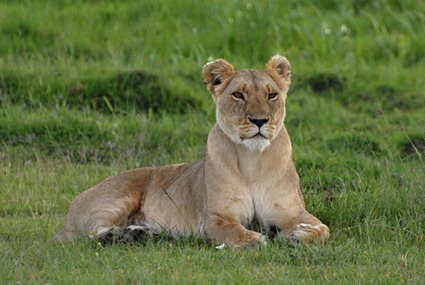
White Eye and Bibi, the two remaining original Marsh Pride females, were the last adults to be identified by the Serian Camp guides. Jonathan Koikai quickly pointed out the unmistakable female with her missing eye.

whiteeye-charm-siena
White Eye (left), Charm (centre) and Siena (right) are now the pride leaders, together with Bibi (below)
bibi sitting


Finally, we tracked down the young females that are Bibi, Lispy, Red and White-Eye’s older cubs. Still youngsters, the four girls were playing with two tortoises that they had found. Although lions can eat everything from mice to elephants, these hard cased critters proved too much for these inexperienced lionesses!

marshgirls
You might want to remove the outer packaging!

So it is now clear that we’ve lost Lispy. As a core female in the Marsh Pride for many years, it is certainly a loss. However, at the ripe age of 13, Lispy has been a successful mother for a decade, and has left behind some formidable descendants. With the reunion of the main pride and the Three Graces, I have little doubt that the Marsh Pride will continue to thrive as the best loved lions of the Masai Mara.
lispy
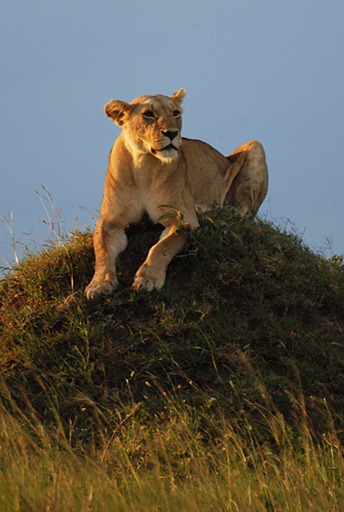
Lispy looks out over her territory of the Musiara Marsh


Sara
The Marsh Pride’s Family Vacation

Sunday, May 9, 2010

Posted by Sara Blackburn at 4:50 PM

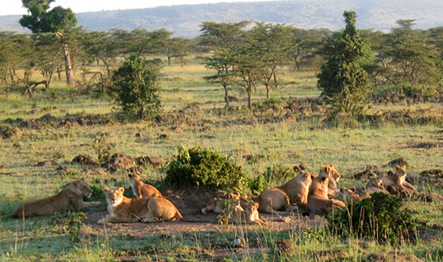
This morning I drove out of camp to be met by a gang of thirteen very special lions. Within the bunch was a number of youngsters, along with some familiar faces.
Just outside of Serian, Chemi-Chemi (the spring) is in the northern reaches of the Mara North Conservancy on the Mara River. It’s certainly some distance from the Musiara Marsh, which is why I was surprised to identify the lions as none other than the infamous Marsh Pride.

marshpride
How many lions?!

Four adults – Siena and Joy, Bibi and White Eye were lazing in the sun with Romeo and a whole assortment of cubs. Joy's two male cubs, now around 15 months old, and six cubs around 5 months old – four belonging to White Eye and two to Siena – were all happily playing in the long grass and exploring their new environment.

climb The cubs practiced their tree climbing skills amongst the Acacia

The pride have been slowly working their way into the conservancy, and have been spotted on a number of occasions. Although they are far from their home, the territory is open, as many of the River Pride lions are residing on the escarpment. Romeo too has visited the area often to mate with new females.
A lion’s pride territory is not as fixed as you’d think. Although lions spend a lot of time in a core area, prides rangers are large and overlapping. However, two prides will not occupy the same shared territory at the same time, and will advertise their presence to neighbouring prides by roaring.

White Eye the one-eyed lioness. A caring mother but also a fierce hunter

The Marsh Pride is also in a state of flux – with Clawed (Mpengo) seemingly absent, Red no longer with us and the five sub-adults from the females’ last litters, the large family has split into a number of sub-groups. It seems that White Eye and Bibi are forming an alliance with the Three Graces – including Siena and Joy – whilst Lispy remains with the daughters of the pride. Lispy has also been seen flirting with two handsome chaps from the border of the Marsh. Perhaps Romeo and Clawed’s reign is facing an uncertain future?
However the pride forms, here’s hoping that the Marsh females will be as successful at raising this family as they were with the last. They’ve got a lot of experience on their paws!
Sara

Red-hot Adventures in the Dark

Saturday, September 12, 2009

Posted by Sara Blackburn at 5:49 PM

This week I’ve been spending some time with cameraman Martin Dohrn, who has worked on Mara Nights and Big Cat Diary. He brought with him some pretty funky equipment – a state-of-the-art thermal camera and also a starlight camera to put through some rigorous testing for Ammonite (www.ammonite.co.uk). These cameras allow us to witness some amazing footage of lion behaviour at night, revealing a world totally different to the one we are used to experiencing during daylight hours. The thermal camera reads the heat given off by animals (and rocks, we discovered!).
Lions are very active at night, using the cover of darkness to ambush their prey. During a full moon, lion have little advantage over the plains game, who also have generally good night vision. However, the nights after a full moon begin with a period of total darkness before the moon rises, during which lions have a significant advantage over their prey. We aimed to film during these hours to hopefully capture some cool lion action on film.
We had some fun-time with the Marsh cubs, hassling hippos and giving us the run around over luggas (dry river beds) and swamps. With only infra-red goggles to guide us, navigating the many holes and water tracks was a challenge! We spent several nights with the group, and watched the Marsh males Romeo Clawed scoffing a wildebeest kindly brought down by Lispy. This she caught just before sunset, calling in her family to share the goods. The moon was bright, and so we were able to get some excellent footage with the starlight camera, which operates in extreme low light conditions.
The following night we made our was into the Mara North Conservancy (MNC) with the hope of finding some active lions. It has been raining rather heavily, but that didn’t stop us tracking down Caesar and the three girls from Elephant Pepper in Military. As the sun went down, they slowly made their way onto the plains. We had two hours of total darkness before the moon rose and they looked pretty hungry, so we were feeling lucky.
At this point it’s worth noting how differently the animals behave at night. Wildebeest who are usually grazing or resting during the day migrate on to the hills, clustering together for protection through strength in numbers. Thompson’s Gazelles find a quiet spot and lie down silently, adopting the tactic of invisibility. Topi stumble awkwardly in the darkness, and Impala walk with their heads to the ground in the hope of picking out a cat-like silhouette. The lions on the other hand stroll out with confidence and a spring in their step, their incredible night vision obvious. It’s amazing watching a lion walk within yards of herds who are totally oblivious to their presence.
First, the lions tried their luck with an ostrich. It was a pretty casual hunt and an opportunistic one, more amusing than successful for the lions. Slowly they made their way to the panicked herds, which by now knew they were not alone and streamed across the thermal camera. The images are truly amazing – the heat of the animals shows them up like city lights in amazing clarity. For several hundred or even thousand meters you can pick out animals clear as day.
The lions repeatedly ran into the herds, scattering them as they attempted a kill. They came close, but failed to seal the deal. Caesar then peeled off from the girls, moving round the back of the herd. Spooked, they ran straight towards the awaiting lionesses, and sure enough, one of our girls chased down a sizeable youngster. The thermal camera captured the entire event in amazing clarity, and we were able to watch our lioness stretch out in full run and tumble with her kill to the ground.
After despatching the wildebeest, the girls had only a nibble before Caesar tucked in. This is usual behaviour with lions – the lionesses bring down a significant percentage of kills, but the male gets the lion’s share and first dibs. This might seem unfair, but without him there, hyenas would quickly overpower the lionesses. Indeed, we watched Caesar run full stretch at some cheeky hyenas that came a bit too close.

thermalCaesar and one of the girls with their kill, shown as a mega cool inverted image. You can see how the thermal works this way – the hot points such as the eyes show up as black areas, whilst the cool ground and Caesar’s mane show as white.

Together with a hyena kill and other incredible footage, we left the MNC to film another day. Martin will be coming back in October, and I hope to spend some more time observing the lions at night. It is fascinating observing their hunting behaviour, and witnessing just how different – and active – these cats are when then have the cover of darkness.
I might just forgive the next lion I find asleep in the middle of the day!!
More soon – I’ve just heard we have some visitors rather near our camp!
Sara

Learning the Ropes

Friday, July 10, 2009

Posted by Sara Blackburn at 4:26 PM

The Mara landscape changes quite dramatically with the seasons, and with the rains comes tall grass and swampy plains. The rains also mark a drop in the number of visitors to the Mara – not only does it pour down, but even the toughest vehicles find the mud a challenge!
The lions certainly seem to take advantage of the change of seasons, using the long grass and quiet times to their hunting advantage. The long grass is a bit of a trade off – although it provides excellent cover for stalking lionesses, game becomes more scarce.

stalk Bibi shows a classic stalking pose – body close to the ground, ears pricked, eyes fixed on the prey and moving silently and slowly under cover.

The Marsh Pride have certainly reacted to the changes, and are spending more time out of the Masai Mara Reserve and moving into the North Mara Conservancy where the grass is shorter. The four lionesses are usually exclusively night-time hunters, but of late, the lions have been hunting more during the day. Last week saw them stalking wildebeest in the heat of the day – not so typical of lazy lions!

giraffe2 I think their eyes are bigger than their stomachs!

The Marsh cubs are also growing up fast, and are keen to practice their skills. They are full of enthusiasm, but often far too bold and confident for their own good. Full grown giraffes aren’t usually on the menu for lions! Even though they may not get a meal, each bold move on potential prey species is a valuable learning experience, and the cubs are always perfecting their stalking and ambush skills. Playtime is just as important for them, too, as it’s not all about having fun – cub play is full of hunting and social learning.
giraffe While the giraffes focussed on the lionesses, the cubs crept to a close distance

Earlier this week, Stacey brought down a full grown zebra for her 5 month old cubs. This is an impressive achievement for her, and she held it down for some time to allow her cubs to learn some techniques. Although it may seem cruel, life and death is an everyday matter for predators and prey, and if they are to grow to be healthy, independent adults, these cubs must learn to be as successful as their mother.
Sara