In order for us to learn about the lions in our area, we first need to identify them so that we can track individuals. From this we can learn about pride ranges and identify key areas for lions. We can also try and establish what causes the lions to move around.
Lions change greatly in appearance over time - males especially can become unrecognizable in a matter of weeks throuhg changes in condition and encounters with other lions. Injuries and scars heal remarkable quickly, and lions often gain new ear tears.
Each lion has its own character, and some features can certainly be useful in identifying individuals. Prominent ear tears, face shape, age, and major infuries such as missing tail tips and scarred noses can all be used with recent photographs. However, only the whisker spot pattern remains the same throughout a lion's life.
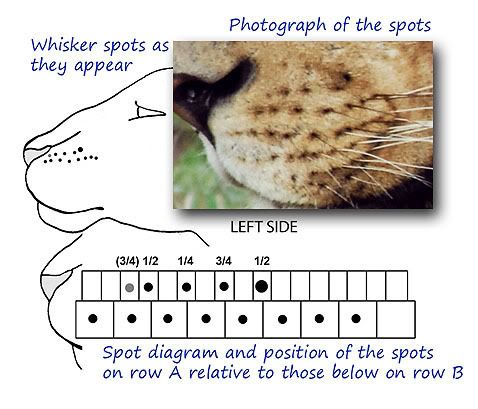
So what is this pattern? On each side of a lions muzzle, whisker spots lie in rows. Not all of these have virbrissae (whiskers), and the pattern differs on both sides on the face.
We look at a certain area of this pattern to identify our lion. The uppermost complete whisker spots is referred to as row B, or the reference row. Above this row are often found several randomly spaced spots - usually from 1 to 4. These form what we call row A. We are interested in the position of row A spots in relation to the position of row B spots. This remains the same from birth to death, and acts the same as a human fingerprint.
Click here to visit the MPP Database page on I.D.ing lions, and study the image below to help you.

Unfortunately, as a lion ages and the fur on the muzzle becomes patchy and worn, its whisker spots become increasingly hard to distinguish. At this age, however, the lion has usually collected enough permanent battle scars to aid with its identification.
More soon on how to age lions - another essential to working out who's who.
Sara
Lions change greatly in appearance over time - males especially can become unrecognizable in a matter of weeks throuhg changes in condition and encounters with other lions. Injuries and scars heal remarkable quickly, and lions often gain new ear tears.
Each lion has its own character, and some features can certainly be useful in identifying individuals. Prominent ear tears, face shape, age, and major infuries such as missing tail tips and scarred noses can all be used with recent photographs. However, only the whisker spot pattern remains the same throughout a lion's life.
So what is this pattern? On each side of a lions muzzle, whisker spots lie in rows. Not all of these have virbrissae (whiskers), and the pattern differs on both sides on the face.
We look at a certain area of this pattern to identify our lion. The uppermost complete whisker spots is referred to as row B, or the reference row. Above this row are often found several randomly spaced spots - usually from 1 to 4. These form what we call row A. We are interested in the position of row A spots in relation to the position of row B spots. This remains the same from birth to death, and acts the same as a human fingerprint.
Click here to visit the MPP Database page on I.D.ing lions, and study the image below to help you.
Unfortunately, as a lion ages and the fur on the muzzle becomes patchy and worn, its whisker spots become increasingly hard to distinguish. At this age, however, the lion has usually collected enough permanent battle scars to aid with its identification.
More soon on how to age lions - another essential to working out who's who.
Sara

 Posts
Posts